A proactive approach to workplace violence in healthcare

Unsafe behavior, like history, may repeat itself. Collective identifies historical security events and notifies staff prior to engaging with a patient, so they can plan accordingly.

JACK’S STORY

Unsure how to access primary care, Jack turned to the ED for his daughter’s pediatric asthma attacks

Jack’s daughter had repeated and alarming asthma attacks. Uninsured and working several jobs to make ends meet, he took her to the only place he knew he could get her immediate care at any hour—the hospital emergency department.

Through the Collective platform, care managers were notified of Jack’s daughter’s repeated ED visits. The day after his daughter’s most recent ED visit a nurse reached out to Jack to better understand his situation, help him navigate his options through Medicaid, and work with him to schedule an appointment at a primary care physician with evening hours.

She hasn’t needed an ED visit since.

(Anonymized patient story)

Alerts designed to support the unique needs of the emergency department

In the ED, seconds matter. Collective curates patient data into a focused alert to help ED providers make rapid, informed decisions for better patient outcomes.

Collective information at the point of care

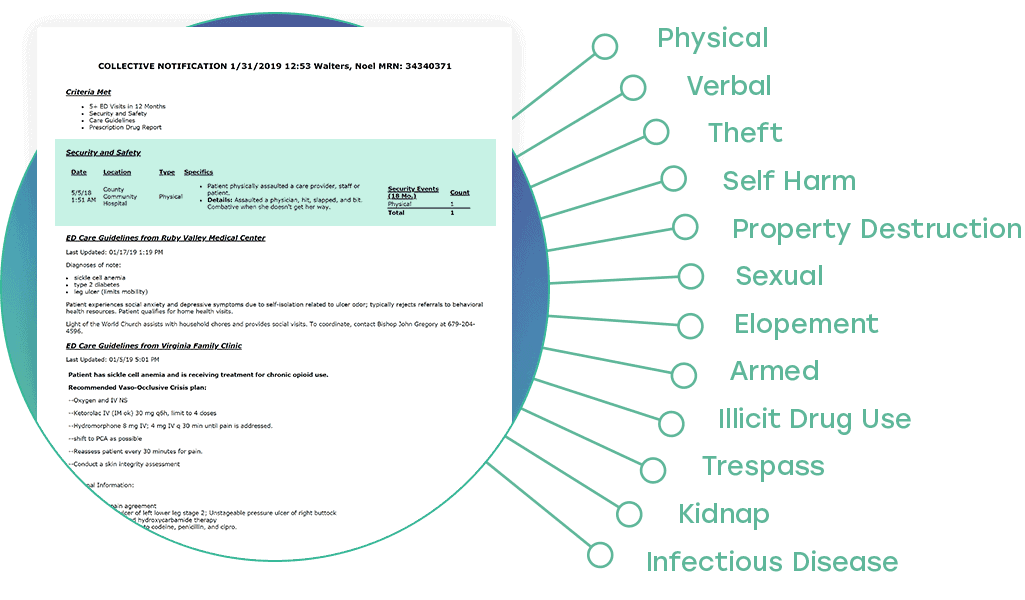
Help protect your care team members with Collective’s security and safety events notifications

A significant indicator of a patient’s risk for violence is a history of violence. As soon as a patient with a historical event at any facility on Collective’s nationwide network registers, alerts are immediately sent to providers and security staff, empowering teams to realign resources and respond—saving time, money, and preventing injury. Types of security events captured by Collective include:

In a recent ACEP survey of ED physicians, 8 of 10 reported that violence in the ED interrupted patient care

0 %

Reduction in overall
ED Medicaid visits

0 %

Reduction in ED visits
among frequent utilizers

0 %

Reduction in low-acuity ED
visits

0 %

Reduction in narcotic prescriptions from the ED

Survey conducted online between 8.21.2018 and 8.27.2018 with 3,539 emergency physicians; newsroom.acep.org
Source: The Brookings Institution

Collective security and safety events provides actionable data for a safer workplace

Identify

Easily identify patients who are prone to be security or safety concerns by gaining knowledge of past actions across the Collective network.

Measure

Verify that new workflows and preventive actions are successfully preventing harm by measuring instances of dangerous behaviors before and after.

Identify

As information is gathered and compared, workflows and processes can be continually refined as instances of harm are reduced and eventually eliminated.